Showing posts with label pragmatics. Show all posts

Monday, September 9, 2013

Weber: From Max Weber (1948)

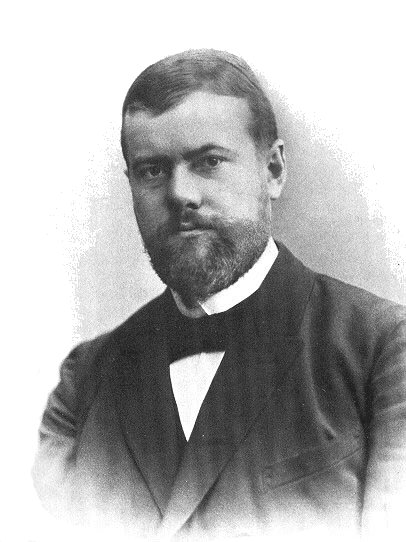
Max Weber in 1894 (image from Wikimedia).
The most thought-provoking piece in this anthology is chapter 10, "The Meaning of Discipline." The chapter an excerpt from Weber's Wirtschaft und Gesellschaft, and it contains a discussion of the way charismatic authority is consolidated into discipline once heroic or spirited leadership turns into everyday goverment and bureaucracy.

Everybody in the Army!

Weber is very clear about what he considers as the origins of discipline:
The discpline of the army gives birth to all discpline. (p. 261)
After discpline has been established in the army, however, it can spread to other sectors:
… discipline has always affected the structure of the state, the economy, and possibly the family. (p. 257)
For instance:
When infantry drill is perfected to the point of virtuosity (Sparta), the polis has an inevitably 'aristocratic' structure. When cities are based upon naval discpline, they have 'democratic' structures (Athens). […] The rule of the Roman participiate, of the Egyptian, Assyrian, and finally of all the modern European bureaucratic state organizations—all have their origin in discipline. (p. 257)
OK, that was a bit fast on the trigger, cowboy, but I see what you're saying.

Discipline in the Factory

The principles of "scientific management" may also be explained in this way, according to Weber. In this respect, he has foreshadowed countless modern commentators, so I'll quote this at some length:
No special proof is necessary to show that military discipline is the ideal model for the modern capitalist factory, as it was for the ancient plantation. In contrast to the plantation, organizational discipline in the factory is founded upon a completely rational basis. With the help of appropriate methods of measurement, the optimum profitability of the individual worker is calculated like that of any material means of production. On the basis of this calculation, the American system of 'scientific management' enjoys the greatest triuphs in the rational conditioning and training of work performances. The final consequences are drawn from the mechanization and discipline of the plant, and the psycho-physical apparatus of man is completely adjusted to the demands of the outer world, the tools, the machines—in short, to an individual 'function.' The individual is shorn of his natural rythm as determined by the structure of his organism; his psycho-physical apparatus is atuned to a new rythm through a methodical specialization of seperately functioning muscles, and an optimal economy of forces is established corresponding to the conditions of work. This whole process of rationalization, in the factory as elsewhere, and especially in the bureaucratic state machine, parallels the centralization of the material implements of organization in the discretionary power of the overlord. (p. 261–62)
This translation is in fact quite off on a number of points, so let me just paste the German original in here for reference:
Daß dagegen die »militärische Disziplin« ganz ebenso wie für die antike Plantage auch das ideale Muster für den modernen kapitalistischen Werkstattbetrieb ist, bedarf nicht des besonderen Nachweises. Die Betriebsdisziplin ruht, im Gegensatz zur Plantage, hier völlig auf rationaler Basis, sie kalkuliert zunehmend, mit Hilfe geeigneter Messungsmethoden, den einzelnen Arbeiter ebenso, nach seinem Rentabilitätsoptimum, wie irgendein sachliches Produktionsmittel. Die höchsten Triumphe feiert die darauf aufgebaute rationale Abrichtung und Einübung von Arbeitsleistungen bekanntlich in dem amerikanischen System des »scientific management«, welches darin die letzten Konsequenzen der Mechanisierung und Disziplinierung des Betriebs zieht. Hier wird der psychophysische Apparat des Menschen völlig den Anforderungen, welche die Außenwelt, das Werkzeug, die Maschine, kurz die Funktion an ihn stellt, angepaßt, seines, durch den eigenen organischen Zusammenhang gegebenen, Rhythmus entkleidet und unter planvoller Zerlegung in Funktionen einzelner Muskeln und Schaffung einer optimalen Kräfteökonomie den Bedingungen der Arbeit entsprechend neu rhythmisiert. Dieser gesamte Rationalisierungsprozeß geht hier wie überall, vor allem auch im staatlichen bürokratischen Apparat, mit der Zentralisation der sachlichen Betriebsmittel in der Verfügungsgewalt des Herrn parallel. (pp. 686–87)
I always get a sense that Weber wrote sentences like this when he was in the most gloomy mood, imagining a dismal future society of complete bureaucratization and control. As for Marx, Heidegger, and others, this sense of unease was ambiguous between a romantic protest against alienation and a more cynical mapping out of the mechanics of power.


Pragmatics at the Dentist

There is just one more thing I would like to quote, mostly out of a linguistic interest. This comes from the essay "The Protestant Sects and the Spirit of Capitalism."

This essay was written after Weber's book on protestantism. Its main claim is that membership of esoteric church communities was used as an indication of one's creditworthiness in the USA of Weber's day. This made sense both because of the moral doctrines of the communities, and because membership was expensive.

In the beginning of the essay, Weber relates the following anecdote:
The matter became somewhat clearer from the story of a German-born nose-and-throat specialist, who had established himself in a large city on the Ohio River and who told me of the visit of his first patient. Upon the doctor's request, he lay down upon the couch to be examined with the nose reflector. The patient sat up nce and remarked with dignity and emphasis, 'Sir, I am a member of the –––––– Baptist Church in –––––– Street.' puzzled by about what the meaning this circumstance might for the diease of the nose and its treatment, the doctor discreetly inquired about the matter from an American colleague. The colleague smilingly informated him that the patient's statement of his church membership was merely to say: 'Don't worry about the fees.' (p. 304)
The reason I found this such a nice example is that it shows how completely obscure pragmatic inferences sometimes are, and how wrong communication can go when the right common ground is absent.

Wednesday, September 4, 2013

Mills: Gender and Politeness (2003)

The most interesting argument in this book by Sarah Mills is that we cannot treat politeness as a matter of form. Meaning is extremely context-dependent, and people often spend quite a lot of time and mental resources trying to figure out how whether something was a sarcastic jab, a polite compliment, or something completely different.


The Indeterminacy of Politeness


Front cover, from amazon.com.
As an example of such a case of very real uncertainty, Mills relates a story of a woman who asks a man whether he has any change for the payphone just as he exits the booth (p. 84). He tells her that there is 80p of credit left in the phone, and that she can use that, and she replies
  • Thank you VERY MUCH; thank you VERY MUCH.
The man, who was Libyan but experienced this incident in Britain, was later unsure what exactly to make of this comment. He wondered whether she thought that he "had been stupid to be so generous to a stranger" (p. 84). Possibly, she could also have been ironically remarking that the gift had been too small rather than too big. Or perhaps she really just meant to thank him.

A more straightforward example (p. 80) is that of a teacher telling her class,
  • Can you PLEASE be quiet?
Obviously, this is not a matter of the teacher subserviently bowing and scraping for the kids, but rather quite forcefully giving an order. (I'm sure you have heard an equivalent of this exact sentence back in your school days.) Mills attributes this example to Mark Jary (1998).

In both cases, the linguist can't simply sit on a mountaintop and claim to have special insights into the meaning and force of the things that people say. If you want to know whether something appears as polite or impolite to the participants in a conversation, you need to ask them.

Deep and Shallow Conversational Themes

The fifth chapter of the book, also called "Gender and Politeness," largely takes the form of a prolonged criticism of the book Men, Women, and Politeness (1995) by Janet Holmes.

Mills correctly criticizes her for having a way too superficial conception of the relation between form and function, and for ignoring or explaining away data that doesn't fit her theory. On a theoretical level, nothing is done here which has not already been done better and more pointed by Deborah Cameron, but it's perhaps still worth the time to see in detail where the seams come apart.

By way of illustration, Mills analyses two telling examples of mismatches between stereotypically "mannered speech" and the real motivations of the participants. One example is about excessive thanking between women (pp. 227–31), and the other is about two women having a discussion while a largely quiet man is also present in the home (pp. 231–34).

Lovely, Lovely

In the first of these examples, a woman codenamed "D" gives a Maori shell as a present to her hosts, who proceed to thank. One participant, codenamed "M," for instance shoots off this tirade (p. 228):
  • … oh, that's lovely. lovely, isn't it? […] oh, that's lovely, thank you very much, I love the colours …
On the face of it, this seems like a perfect example of stereotypical "women's speech," but in her interviews with the participants, Mills actually found that, during this exchange, the women were in fact trying to shut up D so that they could to get on with their lunch. This led to a kind of unfortunate spiraling effect, since D took thanking as an invitation to talking, and her talking led the other women to ramp up their thanking.

Again, had Mills been sitting in her office handing out judgments of what this or that utterance meant, she would probably only have added yet another layer of misunderstanding, and largely misread the subtext of the conversation.

Pointing the Camera the Wrong Way

The other example concerns a conversation between two participants, two women who are old friends, and the partner of one of them. The exchange centers around a misunderstanding — the woman codenamed A is visiting the couple, planning to go out with them, but the host couple then realize a bit too late that she didn't come by car as they first thought.

A then apologizes quite heavily (p. 232):
  • I'm sorry, I've, um, messed up all the plans.
Mills comments:
Focusing only on the way that A explicitly apologizes, which conventional politeness theories such as Holmes do, would not allow us to focus on the way that in this interaction questions of the sex of the participants is not particularly salient. (p. 234)
Instead, the exchanges surrounding the misunderstanding all could instead be seen as a collaborative project of building and maintaining intimacy, so that
… they can present themselves as a group of friends who get on well together because they can resolve conflicts jointly, not allowing difficulties and misunderstandings to threaten anyone's face. (p. 234)
So, looking for superficial cues like I'm sorry would very likely lead an analyst to think that A was very explicitly gendering herself in this dialogue. But in fact, one could just as well focus on the quite forceful way that the other female speaker asserts herself during the dialogue, or the much more withdrawn role of the male participant. From that perspective, the use of apologies, teasing, and irony would be seen much more as a product of the local context.

Wednesday, April 3, 2013

Johan van Benthem: "Games that make sense" (2008)

This is a chatty note on the various uses of game theory in semantics and pragmatics. It makes two points that I find worth mentioning.

First, van Benthem correctly points out that there are two different notions of "game" in play in semantics, and that these are sometimes confused. One is Hintikka-style verification games, and the other is Parikh-style signaling games. Although the verification games may in some sense be taken as idealized roadmap for a conversation, this fact is not completely obvious and cannot be taken for granted.

Second, he notes that signaling games have thrown a lot of the syntactic and semantic structure from logic overboard in its attempts to model the emergence of meaning. Since logic usually models hard, conventional facts about a language, this means that game-theoretic approaches to pragmatics have a hard time getting off the ground, because they take everything to be up to debate and revision in the online conversation situation. This is a false assumption in many cases.

Van Benthem writes:
Finally, from the viewpoint of natural language, we have not even reached the complete picture of what goes on in ordinary conversation. There may be games that fix meanings for lexical items and for truth or falsity of expressions whose meaning is understood. But having achieved all that, the ‘game of conversation’ only starts, since we must now convey information, try to persuade others, and generally, further our goals – and maybe a bit of the others’ as well. (p. 7)
He gives a tip of the hat to a number of people in dynamic epistemic logic and then continues:
But conversation and communication is also an arena where game theorists have entered independently, witness the earlier references in Van Rooij [42], and the recent signaling games for conversation proposed in Feinberg [22]. Again, there is an interface between logic and game theory to be developed here, and it has not happened yet. (p. 8)
But certainly a number of people are currently trying to smuggle more logical assumptions into the games, with various levels of success. 

Thursday, November 8, 2012

Shuy: The Language of Defamation Cases (2010)

Roger Shuy is a so-called "forensic linguist," meaning that he appears as an expert witness in court cases that centrally involve questions about language, such as libel suits. He's written a number of books reporting on cases he's been involved in, the most recent being The Language of Defamation Cases.

His discussions are interesting because they show how quickly our unreflected notion of "meaning" starts to come undone when it gets exposed to the extreme hair-splitting that libel suits unavoidably entail. "What a statement means" becomes less rather than more clear when you look at it up close.

Frank Celebrezze v. The Plain Dealer

In 1986, the (Republican) Cleveland newspaper The Plain Dealer ran a series of stories about the (Democratic) Ohio Supreme Court justice Frank Celebrezze. Shortly thereafter, Celebrezze lost the race for re-election for the Supreme Court.

Before the publication of the articles, Celebrezze had taken campaign donations from labour unions, and some of these labour unions had members who were convicted of involvement in organized crime. As a judge, he had also voted against the conviction of people accused of organized crime at least twice.

So, one might conjecture that he was corrupt, and the mafia had bought his vote — and this was exactly what the two journalists Gary Webb and Mary Anne Sharkey claimed in a series of Plain Dealer articles, published immediately before the Supreme Court election.

Or was it? A closer reading of the articles in question revealed that they did not directly state that Celebrezze was corrupt, but one might argue that they suggested as much. Celebrezze consequently sued The Plain Dealer, and both he and the paper hired linguists to back their case.

Shuy represented the paper, and a local English professor was made Frank Celebrezze's case. Both experts wrote a report, but the case was eventually settled outside the court for an undisclosed sum.

The Apple of Discord

A number of quotes were brought to bear on the case. Most of them were headlines like this one:
Chief Justice denies mob role in contributions (p. 101)
But also some excerpts from the articles themselves were used, including this one:
In 1982 Celebrezze cast a tie-breaking vote against convicting Liberatore of arson. State records show that five days later, a Celebrezze campaign fund was given $5,000 … (p. 103)
The question was: Do these two sentences together imply that Celebrezze received the campaign donation as a result of his vote, or does it not?

The Argument Pro

According to Celebrezze's expert, both snippets of text indirectly implied that Celebrezze was guilty. With respect to the headline, the argument was a pragmatic one about presupposition:
If the headline had read Chief Justice Says Accusations Concerning Mob Role are False then the presupposition would have been that someone had made such accusations, not that the mob role was a given fact. (p. 101–102)
In other words, the claim is that the verb deny is veridical, or factive, while accusations concerning is not.

In the case of the quote, the argument refers to discourse coherence relationships:
Juxtaposing the two claims (that the judge had cast a tie-breaking vote and received money five days later) creates the obvious innuendo that there is a cause and effect relationship between the vote cast and the money paid. (p. 103)
So a reader searching for a coherent link between the two sentences will stumble upon cause–effect as the first likely candidate. This can be compared to the following examples, adapted from Jennifer Spenader:
  • Bill is worried that John might try to gain access to his safe. He'll have to change the combination. (therefore)
  • Bill is worried that John might try to gain access to his safe. He knows the combination. (because)
  • Bill is worried that John might try to gain access to his safe. I like spinach. (??)
Although the general claim that people will automatically search for discourse relations is sound enough, it is worth remembering that the choice of discourse relation is notoriously difficult to consistently agree on.

Arguments Contra

Shuy's own argumentation focused on the impotence of linguistics with respect to what a reader will extract from a text, or what the motives of a writer are:
There is no way that a linguist can actually reach inside the mind of the writer to determine what that writer intended. (p. 107)
There is no way that linguistic analysis can prove such attributions of a person's intentions. (p. 109)
The plaintiff's expert's use of expressions such as "must have," "they are affected," and "readers would" attribute results or behaviors [to the reader] that linguistic analysis simply cannot provide. (p. 111)
This is a surprisingly self-defying argument to hear from a person who is himself a forensic linguist. If it were really the case that linguistics has nothing to say about how a text works or what it reveals about the author, what is it doing in the courtroom in the first place?

The argument is also strange given that Shuy in the same chapter explains that he once had a courtroom disagreement with another linguist who "actually agreed with my conclusions but claimed that the field of linguistics could lead neither of us to such findings" (p. 98). To my ears, this sounds surprisingly close to saying that there is "no way that linguistic analysis can prove such attributions of a person's intentions."

The Flexibility of Forensic Linguistics

Further, when Shuy appears on the other side of a court case, he also seems to embrace a much more liberal approach to meaning:
Otherwise benign words and expressions, such as "made plans," "was alone," "secretly left the house," "went unanswered," "left town," and "living with," can convey meanings far beyond their usual dictionary senses, especially in the context of a broadcast about a murder. (p. 61–62)
But oddly, this is not the case with words like deny in the context of newspaper reporting on mob crime.

It seems that the conclusion we can draw is that linguistics either can or cannot say something about meaning, depending on whom its employer is on a given day. In the murder case (chapter 4), journalists are thus clever manipulators setting up snares for their helpless sources and listeners:
Most listeners are not very likely to notice the discourse framing of the broadcasts or that there was little attempt to clarify important ambiguities. (p. 68)
But in the corruption case (chapter 7), they have regained their agency, and the newspaper is liable only for explicit accusations, not innuendo:
… there is no such accusation in the articles, which present the facts about the relationship between the plaintiff and the local unions … The Plain Dealer claimed that the readers could draw whatever conclusions, if any, that these facts suggest to them. (p. 115)
Probably, the oscillation between these two poles of semantic theory is destined to go on as long as linguists continue to see meaning as a feature of words rather than situations.

Wednesday, November 7, 2012

Vendler: "Each and Every, Any and All" (1962)

This paper was first published in Mind in 1962, by just like everybody else, I read the version reprinted in the Linguistics in Philosophy (1967). It discusses the meaning of the words in the title and is famous for having described the meaning of any in terms of a certain "freedom of choice" (p. 80).

Each, Every, and All

Vendler describes the differences between each, every, and all in terms of collective reference vs. individual reference. His theory is that all is collective, while each and every are distributive.

We thus have differences like
  • You can buy each of these items for $5 (distributive)
  • You can buy all of these items for $5 (collective)
Every, on the other hand, can be seen as a quantification over all the distributive attributions so that "every is between each and all" in meaning (p. 77). We thus get — according to my intuitions — slightly more ambiguous examples with every:
  • You can buy every one of these items for $5
According to my intuition, this could lean towards both a collective ($5 in total) and a distributive reading ($5 per item).

The Blank Check

Vendler describes his ideas about any nicely in this quote:
To say
Any doctor will tell you …
is to issue a blank warranty for conditional predictions: you fill in the names. You choose Dr. Jones; well, then he will tell you if you ask him. You pick twenty-five others; then, I say, they will tell you if you consult them. (p. 85)
 This means that
… the any-proposition is an unrestricted warranty for conditional statements or forecasts and, we may add, for contrary-to-fact conditionals. In other words, to draw an obvious conclusion, it is an open hypothetical, a lawlike assertion. (p. 89)
 I like the phrase "open hypothetical." It both highlights why any can be used in couterfactuals and other modals, and why it does not have existential import.

Vendler also notes that every single time any is used, it issues this blank warranty anew:
… I can certainly not say
*He took any one
even if you acted on my words: Take any one. […] Any calls for a choice, but after it has been made any loses its point. (p. 81)
In other words, once all the facts are settled, you cannot use any to make a report, since "facts are not free" (p. 84).

Any and The Pragmatics of Preferences

One more quote from his explanation:
With Take any one, it is up to you to do the determining; here it does not make sense to ask back, Which one? Thus while in the former case [Take one] I merely fail to determine, in the latter case [Take any one] I call upon you to determine, in other words, I grant you unrestricted liberty of individual choice. (p. 79–80)
He notes that this also explains why a command like You must take any seems odd. Interestingly, though, the British National Corpus does contain examples like the following:
  • You must report any losses immediately.
It is probably fair to paraphrase this sentence as
  • If you have any losses, you must report them immediately.
So it appears that you can in fact order people to take any apple, but only if they are placed in an environment in which they are exposed to apples, and they be tempted to not take all of them (so to speak).

A Probabilistic Interpretation of Any

The last thing Vendler does in the article is to informally sketch a way that the difference between any, every, and all could be implemented in a compositional probabilistic semantics:
A bag contains a hundred marbles. We inspect ten at random and all ten are red. Then the probability that any one marble we care to pick out of the hundred will be red is quite high. Yet the probability of every one's being red is much lower. (p. 94)
 I interpret this the following way: When you evaluate the formula
  • All the marbles are red.
you are really asking for the posterior probability that the relevant parameter is 1. When you ask
  • Some of the marbles are red.
you are asking for the posterior probability that the parameter is larger than 0. However, when you evaluate the formula
  • Any marble we draw will be red.
you are looking for the posterior probability that one randomly drawn marble will be red, given your evidence. This amounts to summing up the probabilities of the statements
  • The bag contains 100 red marbles, and if I draw one at random, it will be red.
  • The bag contains 99 red marbles, and if I draw one at random, it will be red.
  • The bag contains 98 red marbles, and if I draw one at random, it will be red.
To take an example with slightly lower numbers, suppose I have drawn a marble twice from a bag of 10 marbles, and that in both cases, I drew a red marble. Then the posterior probability of the different parameter settings are shown in the graph below:


With these numbers, we get the probabilities
  • P("All marbles are red") = P(p = 1 | k = 2, n = 2) = 26%
  • P("Some marble is red") = 1 – P(p = 0 | k = 2, n = 2) = 1 – 0% = 100%
  • P("Any marble is red") = Σi P(p = pi | k = 2) * P(k = 1 | p = pi, n = 1) = 79%
The sum in the last line then ranges over all the parameters values p = 0, 0.1, 0.2, 0.3, …, 0.9, 1. As stated by Vendler, the probability of the any-sentence is substantially higher than the probability of the all-sentence.

Monday, October 29, 2012

Horn and Kato: Introduction to Negation and Polarity (2000)

My "negative polarity" reading list currently includes
So far, I've read a chunk of Ladusaw's thesis and the introduction to Negation and Polarity.

The Dull Edge of Negation

Horn and Kato quote an interesting observation by Otto Jespersen (1917) about the historical trajectory of negation marking:
The history of of negative expressions in various languages makes us witness the following curious fluctuation: the original negative adverb is first weakened, then found insufficient and therefore strengthened, generally through some additional word, and this in its turn may be felt as the negative proper and may then in course of time be subject to the same development as the original word. (Jespersen 1917, p. 4, quoted by Horn and Kato on p. 3)
The pragmatic choice of word is thus always in a kind of arms race with itself because of its feedback to semantics.

We see the same phenomenon with curses, politeness markers, and slang words – all of which regularly have to be discarded because their original force wears off. A similar thing happens with taboo concepts like disease, stupidity, or madness, which regularly have to be renamed because the last generation of terms has lost its neutral and clinical value.

The Historical Emergence of Negative Polarity

With respect to negation, Horn and Kato dub this phenomenon "Jespersen's cycle" and claim that it "plays a central role in the development of negative polarity and negative concord" (p. 3).

I am not quite sure how they imagine the mechanics of this development looks, and neither of their contributions to the volume seem to focus specifically on this (etymological) question. However, somebody at the ACLC recently told me that it's only by recent convention that the Dutch word hoeven ("need") has become ungrammatical in positive contexts, and this seems to support their claim.

Another case that might support this case is the existence of very obviously conventional negative polarity items like lift a finger, hurt a fly, and so on. As with many insults and politeness markers, these were presumably scalar implicatures before they were turned into conventional lexical items.

Notice also the syntactic parallel between such cases and the traditional examples of negative polarity:
  • Would you mind helping me?
  • *You would mind helping me, wouldn't you?
  • You wouldn't mind helping me, would you?
compared to
  • Do you want anything?
  • *You want anything, don't you?
  • You don't want anything, do you?
I don't know how far this analogy could be stretched, but there does seem to be something buried here.

Thursday, October 11, 2012

Bob van Tiel: "Embedded scalars and typicality" (2012)

Bob van Tiel has, as far as I understand, been arguing for a while that the various empirical problems surrounding scalar implicatures can be explained in terms of typicality. So the strangeness of saying that I ate some of the apples if I in fact ate all of them should be compared to the strangeness of saying there's a bird in the garden if there is in fact an ostrich in my garden.

This argument is nicely and succinctly presented in a manuscript archived at the online repository The Semantics Archive. It contains a fair amount of nice empirical data.

A Bibliography

First of all, the paper contains pointers to most of the interesting recent literature on the subject. Let me just liberally snip out a handful of good references that I either have read or should read:
This list should probably also include the following, which I still have to read:

Quantification According to van Teil

In sections 6 and 8 of the paper, van Teil suggests a very particular semantics for the use of some and any, both extracted from "goodness" ratings by 30 American subjects regarding the sentences All the circles are black and Some of the circles are black.

Semantics for All

His suggestion for the semantics of all is, loosely speaking, that the truth value V("all x are F") should be computed as the harmonic mean of the truth values of V("x1 is F"), V("x2 is F"), etc.

This obviously only makes sense for finite sets, but more strangely, it does not make sense if the truth value 0 occurs anywhere (since the harmonic mean involves a division). Consequently, he has to assume that V("x is black") = .1 when then x is white, and = .9 when x is black.

While this is not completely unreasonable, it does introduce yet another degree of freedom in his statistical fit (remember, he already chose the aggregation function himself), and it be a cause for some caution when interpreting his significance levels.

Semantics for Some

With respect to some, his suggestion is that the paradigmatic case of some circles are black is half of the circles are black. He thus sets the truth value V("some x are F") to be 1 minus the squared difference between the actual case and the half-of-the-individuals case. Ideally, this should give rise to truth value computation of the form
T(k) = 1 – (n/2 – k)2.
However, on the graph on page 17 of the paper, we can see that T(5) < 7 (7 being the maximal "goodness" level), so even when exactly half of the circles are black, we do not get maximal truth. This must be due to some additional assumption like the .9 parameter introduced above, but as far as I can see, he doesn't explain this anywhere in the paper.

One assumption he does make explicit is that
this definition is supplemented with penalties for the situations where the target sentence is unequivocally false (i.e., the 0 and 1 situations) (p. 18)
While these seems relatively innocuous as a general move, we should note that the situation in which exactly one circle is black counts as a counterexample to Some of the circles are black. It also seems to postulate to different mechanisms for evaluating a sentence: First comparing it to a prototype example, and then in addition checking whether it is "really" true. This extra postulation makes his typicality model lose a lot of its attraction, since it discreetly smuggles conventional truth-conditional semantics back into the system rather than superseding it.

Van Tiel's Comments on Chemla and Spector

While the rest of the paper is reasonably clear, there is one part that I do not understand. This is the part where van Tiel recreates the results from Chemla and Spector's letter-and-circle judgment task.

Here's what I do get: He says that the sentence used by Chemla and Spector,
Every letter is connected to some of its circles
suggests most strongly a some-but-not-all reading (labeled "Mixed"), less strongly an all reading, and least strongly a none reading. So however a subject rates the seven different pictures given by Chemla and Spector (0 to 6 connections), they should respect this constrain on appropriateness orderings.

But then van Tiel says the following:

Using Excel, I randomly generated 5,000 values for each of the three cases such that every triplet obeyed the constraint [that some suggests Mixed more than All, and All more than None]. For every triplet, I calculated the typicality value for the seven situations. Ultimately, I derived the mean from these values for comparison with the results of Chemla & Spector. The product-moment correlation between the mean typicality values from the Monte Carlo simulation and the mean suitability values found by Chemla & Spector was nearly perfect (r = 0.99, p < .001). This demonstrates that Chemla & Spector’s results can almost entirely be explained as typicality effects. (p. 19)
I don't get what it is that he is simulating here. Since he randomly generates triplets (not 7-tuples), the stochastic part must be the proposed "goodness" intuition of a random subject. But how does he go from those three numbers to assigning ratings to all seven cases? I suppose you could compute backwards from the three values to the parameter settings for the model discussed above, but that doesn't seem to be what he's doing. So what is he doing?

I think it would have made more sense to compute the theoretically expected truth value of Chemla and Spector's sentence directly now that he has just gone through such pains to construct a compositional semantics for some and every.

We have the number of connections for each picture, so we can compute the truth value of, say, The letter A is connected to some of its circles; and we also have, in each condition, the set of pictures, so we could compute the harmonic mean of these values for the six truth values that are presented to the subject. Why not do that instead if we really want to test the model?

Sunday, September 23, 2012

Cameron, McAlinden, and O'Leary: "Lakoff in Context" (1988)

In Language and Woman's Place, Robin Lakoff hypothesized that a number of linguistic forms – in particular, hyper-politeness – are markers of "women's language." She speculated that women were encouraged to talk this way from an early age, and that the engine underlying this recommendation was the power difference between men and women.

The short paper "Lakoff in context," first published in Women in Their Speech Communities (1988) and available at this university website, argues that the issue is a little more complicated than that.

First of all, it is not generally true without qualification that women use tag questions like
  • It's a nice day, isn't it?
more often than men. In fact, Cameron et al.'s material suggest that men use tag questions more than women (cf. their table — it's on page 53 of Cameron's anthology On Language and Sexuals Politics).

Secondly, the straightforward relationship between form and function that Lakoff took for granted (tag question = politeness) does not hold up: Tag questions can be used for a number of purposes, including fairly direct attacks.

To get the full range of the uses that are suggested in the paper, I've scanned it for all the corpus examples that it cites. Here's the list:
  • You were missing last week, weren't you?
  • Thorpe's away, is she?
  • But you've been in Reading longer than that, haven't you?
  • His portraits are quite static by comparison, aren't they. (no question intonation)
  • Quite a nice room to sit in actually, isn't it. (no question intonation)
  • One wouldn't have the nerve to take that one, would one? (about a nude picture)
  • It's compulsive, isn't it? (tv host to guest)
  • That's a lot of weight to put on in a year, isn't it (radio show doctor to caller)
  • It's become notorious, has it (doctor to caller, about the caller's crush on a teacher)
  • It is this one, isn't it (teacher to pupil)
  • You are going to cheat really, aren't you (teacher to pupil)
About the last two sentences, I'm not quite sure whether they come from Cameron et al.'s material or whether they're constructed.

In addition to these examples, there is one more which is explicitly attributed to Sandra Harris:
  • You're not making much effort to pay off these arrears, are you (judge to defendant)
It should be pretty clear from this example that tag questions like aren't you? by no means universally signal insecurity or absensce of imposition.

Norris: What's Wrong With Postmodernism? (1990)

This book is like a time machine, effectively taking you back into the middle of the vitriolic debate about "postmodernism" that raged the decade before and after its publication.

Its author, Christopher Norris, is a no-nonsense, British literary critic with a somewhat odd set of allegiances: He admires Jacques Derrida, but hates Richard Rorty; respects Paul de Man but has no patience with Jean Baudrillard; and, more broadly, he is all for deconstruction, but completely antagonistic to most of its American practitioners.

I've read two and a half chapter, and I think I'll move on to some other books in the pile now. But let me just give a couple of quotes from chapter 4, the one about the Searle/Derrida exchange.

First, Norris notes that Derrida is methodologically more in line with Austin's spirit than are his contemporaries in analytical philosophy. Taking distinctions like performative/declaritive or illocutionary/perlocutionary to the extremes to see how much weight they can take is exactly what he was all about:
For if there is one thing that Austin should have taught them – so Derrida implies – is is the need to press these cardinal distinctions as far as they will go, but also to keep and open mind when dealing with instances, anecdotes, off-beat usages, anomalous cases, and so forth which might seem to 'play Old Harry' (Austin's own phrase) with all such tidy categorical schemes. (p. 146)
OK, a second comment which is kind of nicely put: Derrida's point, he says, is to draw attention to
problematic factors in language (catchphrases, slippages between 'literal' and 'figural' sense, sublimated metaphors mistaken for determinate concepts) whose effect […] is to complicate the passage from what the text manifestly means to say to what it actually says when read with an eye to its latent of covert signifying structures. (p. 151)
I think a different way of looking at the same phenomenon is this: When you're trying make your text produce something that it can't really produce (e.g., eternal truths), your rhetoric is going to be leaky somewhere. This does mean that we can't see what you "mean to say," but it does mean that you will always in the process have said something which, strictly speaking, is complete bogus.

Saturday, September 22, 2012

Cameron: "Is there any ketchup, Vera?" (1998)

In reaction to Beborah Tannen's You Just Don't Understand (1990), Deborah Cameron wrote a short and insightful paper that, for various reasons, only got published much later.

In the paper, she argues that the observable differences in women's and men's conversational styles are the visible sign of strategies for handling gender roles rather han direct consequences of either gender differences or gender inequality.

"Thanks, mom"

According to Cameron's summary, Tannen's central thesis is that women and men have different conversational styles, and this leads to systematic misunderstandings. She gives an example, repeated by Cameron on page 79, of a female and a male co-worker walking between two buildings on a cold day. The following exchange takes place:
  • Female speaker: Where's your coat?
  • Male Speaker: Thanks, mom.
According to Tannen's analysis, this is an example of a frustrated communication situation that arises because a typical female move (showing consideration for others) is interpreted by a male hearer as a typical male move (status-grabbing through pecking).

Cameron is uncomfortable with this analysis, among other things because we have no overt evidence that the man actually misunderstood the woman's question. Instead, this "momming" might instead be a case of
'strategic' misunderstanding, where the relativity of linguistic strategies is exploited as a weapon in conflicts between men and women. (p. 86)
Here, the relevant "relativity" would be the two different functions of a question, as an expression of interest, or as a covered command.

"Would you like to finish that report today?"

To illustrate this point further, Cameron cites two more examples. One comes from a magazine advising women in managing positions to use "on record" strategies when giving orders to male employees. Forms like
  • Would you like to finish that report today?
are, in other words, not recommended, since the employee receiving this request could worm his way out of the obligation under the excuse that "if it was really urgent you should have made that clear" (p. 86).

The other example is an anecdote she heard from a friend about a recurring dinner table exchange between the friend's parents (p. 87). Every night, the mother would serve dinner, and the father would ask,
  • Is there any ketchup, Vera?
This was, of course, intended as a request or order and always understood as such.

The Use of Forms

Cameron's point is that the inderect form of request – a "feminine" form according to the stereotype – is not invariably produced in all women and all circumstances. Rather, using one or other form is a matter of choosing the right strategic move in a particular situation.

A key aspect of the situation is indeed the power distribution, and this power distribution is not independent of gender. In the classical dinner table setting, it is thus almost unthinkable that Vera should respond "Yes, it's in the kitchen cupboard," while this might be appropriate if the young daughter had asked (p. 88). On the other hand, as the magazine said, it is absolutely conceivable that a man would exploit this ambiguity strategically; hence the recommendation.

This is not necessarily due to any differences in cognition, nor even global differences in power between the sexes. It is rather the visible trace of a strategy/counterstrategy dialictic that follows in the slipstream of social change and challenges to traditional privileges.

In Camoron's words:
One might paraphrase Marx: 'men and women make their own interactions, but not under conditions of their own choosing'. (p. 91)

Tuesday, May 29, 2012

Aloni and van Rooij: "Free Choice Items and Alternatives" (2007)

This paper argues for a purely pragmatic treatment of some facts about the free-choice items any, irgend-, and qualsiasi (English, German, and Italian, respectively). The manuscript on Maria Aloni's website is dated 2005, but the paper appears to have been officially published for the first time in 2007.

The positive part of the paper is built around a logical implementation of Gricean reasoning. As far as I can see, it is equivalent to assuming that speakers only utter sentences φ that (1) they know, and (2) that maximally informative among the alternatives Alt(φ). This can be formalized in standard epistemic logic. A stronger assumption is later introduced in order to handle some more cases (p. 14).

These assumptions constrain the set of knowledge states that the speaker may be in, and this gives rise to implicatures. For instance, if both p and q are alternatives to the sentence p v q, then the speaker is blocked from uttering the disjunction is she in fact knows that one of the alternatives is the case.

The paper refers centrally to Gerald Gazdar's book Pragmatics from 1979.

Tuesday, May 15, 2012

Chemla and Spector: "Experimental Evidence for Embedded Scalar Implicatures" (2010)

I remember Benjamin Spector seeing speaking about this experiment at ESSLLI 2010. The paper argues that the sentence
  • Every student solved some problems 
has a so-called "localist" reading. A counterexample to such a localist reading is a student who solved no questions, or a student who solved all questions. The second option is the crucial one, since a strict Gricean model does not predict any implicatures that warrant this reading. Chemla and Spector claim that the localist reading is available, although not the dominant one.

Experimental Set-Up and Subject Responses

The empirical method that they employ in order to prove this involves some sentences and some drawings. The drawings show six letters, each surrounded by six circles. Each letter is connected to some number of the circles surrounding it, as in the following figure:


The relevant sentences were then of the following kind:
  • Every letter is connected with some of its circles
In particular, the question was how subjects evaluate such sentences when no letters are completely disconnected, and at least one letter is connected every circle. Will anyone judge the sentence to be false in that scenario?

However, instead of just asking their subjects this question (a methodology that has previously falsified the theory) they asked subjects to click somewhere on a bar connecting the word "Yes" and the word "No." With this methodology, subjects did indeed pick points closer to "No" when the drawing included some letters that were connected to all of their circles.

So it seems that when pushed, subjects do start to doubt whether the word "some" should be taken to mean "at least one" or "at least one and not all." Once they notice this ambiguity, they might become slightly more scared of giving an unequivocal "Yes" and consequently click somewhere lower on the scale.

Or to put it differently, as soon as the subjects start fearing that they are in some kind of polemic language game, they switch to a safer strategy by committing to less. So a localist reading is indeed available, and in some circumstances a possible claim inherent in the sentence.

Relevance Considerations

However, what really caught my eye on this second rereading of the paper was the comments that Chemla and Spector make about relevance while discussing possible experimental set-ups:
the local reading (‘every square is connected with some of the circles and not with all of them’) is relevant typically in a context in which we are interested in knowing, for each square, whether it is connected with some, all, or no circle. Such a context would for instance result from raising the following question: ‘Which squares are connected to which circles?’. (Section 2.2.2, page 365)
The globalist reading, one might add, would be the most relevant answer to the question Which sqaures are connected to some circles? The only counterexamples to the globalist reading consist of sqaures that are not connected to anything, as stated above.

The reason I find this comment interesting is that it connects the meaning of the sentence with the expectation of the subjects. Experimental materials place the subject in some particular role, and this implicitly suggests certain answers to the big question: What does he expect me to do with this question?

Chemla and Spector obviously embrace some kind of objectivist perspective on semantics, with sentences having grammatically determined meanings, and a clear division between grammar and pragmatics. But their sensitivity to the perspective of the subject is very commendable and opens up the possibility of founding the notion of meaning of the notion of social context.

Friday, May 11, 2012

Marc Staudacher: Use Theories of Meaning (2010)

Martin recommended this recent PhD thesis as an up-to-date survey of contemporary philosophies of language. I had a printed version standing around in my office, but it's also available via the ILLC repository of dissertations.

Conventions and Social Norms

The subtitle of the dissertation is "between conventions and social norms," and this is also the central theme of the text: Is meaning a social norm, or is it just a regularity in behavior? In other words, do we conform to the dictionary because we are morally obliged to, or for purely practical reasons?

In chapter 2 of the dissertation, Staudacher reiterates a number of arguments for each of these options. He evaluates two of them as particularly strong, so I will briefly run through those.

Contra: Section 2.1.2

The strong argument against the obligatory and normative nature of meaning comes from a paper by Akeel Bilgrami (from an anthology with discussions of Donald Davidson's philosophy of language).

Bilgrami's claim is that philosophers' urge to give meaning a normative character comes from the fact that they want meaning to depend on something more than mere behavior. In particular, they want to know "what concept" a person's use of a word is supposed to reflect. he argues that this is empirically unnecessary and thus a piece of unnecessary metaphysical fat.

His main example can roughly be restated like this: Imagine an otherwise competent English-speaker that one day says "I have such a horrible headache in my shoulder." The concept-hungry philosopher would then try to uncover some (new) underlying rule or concept behind this (new) application of the word; but Bilgrami emphasizes that we actually don't need such a rule to describe or explain the speaker's behavior. Meaning is thus not essentially normative.

Pro: Section 2.2.3

The argument in favor of a normative concept of meaning is "the argument from mistakes."

This is the observation that we feel inclined to correct people's incorrect use of a word, even if we understand perfectly well what they mean. Think for instance about confusions of the effective/efficient distinction.

It is of course an open question whether such a correction should be seen as benevolent, practical advice or as an expression of moral standards. Perhaps they can be compared to the pragmatic ambiguity of utterances like "You are not allowed to smoke in here."

A Dissociation Device: Section 2.5

In his discussion of the two perspectives on meaning, Staudacher plays around with the idea of a society of completely pragmatic speakers. These mostly use words in their usual meaning, but for reasons that are purely practical rather than ethical. This is a quite useful way of searching out the empirical differences between the two hypotheses.

The most interesting difference between this norm-free universe and the normative one is that hearers will not have any option of condemning speakers for giving false information, and speakers cannot blame hearers for interpreting words in a wrong way. Hearers will thus treat speakers as imperfectly reliable sources of information, like reasonably good thermometers, and speakers will treat hearers as imperfectly reliable reaction machines.

In the terminology of Brown and Levinson, this means that all positive face demands fall out of the game of talking and interpreting. As long as the negative face interests of the two players coincide perfectly (say, they have to communicate in order to row a boat in sync) this will not differ from the normative case. But when one of them has no negative face interests in the situation, or even opposing face interests, then the two hypotheses will be empirically different.

Can Regularities Be Non-Normative?

One thing that I have been speculating about a lot while reading Staudacher's chapter 2 is whether group regularities automatically produces norm enforcement. For instance, if all members of a community drink white wine, will they then necessarily develop a hostile behavior towards people who drink red wine?

The claim of both structuralism and poststructuralism is that they will, since social groups have a tendency to assign meaning to any parameters that distinguish them from others, thus introducing a taboo against borderline cases. The question is (1) whether this is true, and (2) whether this should be explained in terms of individual self-protection or group protection.

This is a quite intricate question and touches on some deeper problems with separating a norm from a regularity. But consider some of these cases of non-conform behavior:
  • One child a school class is smarter than the others; the rest of the class bullies that child.
  • You have had dinner at a restaurant with two friends. They have just ordered a dessert of ice cream with chocolate sauce, and you then order a dessert of low-fat sorbet with a piece of fresh fruit.
  • You have just had dinner with your two friends, and they have both ordered vanilla ice cream. You then order chocolate ice cream.
  • You take a walk on the street, naked.
The question is what the source of the social pressure in these situation is, if there is any. In particular, it is interesting to what degree normalization is good for the group or for any individual.

Right now, my thinking is that social behavior should be understood as stemming from four different sources:
  1. Individual impulse (do whatever you feel like)
  2. Deliberation (do what is expedient and serves your own interests)
  3. Conformity (do whatever everyone else does)
  4. Deliberation for the group (do what serves the common good)
These four dimensions correspond roughly to the pleasure principle and the reality principle of the negative and the positive face of a person, respectively. Note than any two of the dimension can be in conflict with each other. In particular, giving absolute priority to one dogma will yield four characteristic types of behavior:
  1. Whimsical child (Tourette's syndrome)
  2. Clever egotist (psychopathy)
  3. Anxious teenager (sheep behavior)
  4. Paternalistic saint (otherwordly goodness)
With respect to language use, they might be instantiated as follows:
  1. Say what ever you comes into your mind; use Humpty Dumpty meanings
  2. Use words in ways that maximize the desired effects; lie if it helps you.
  3. Use words in standard ways; say standard things; avoid conflict
  4. Speak truthfully; be relevant; be precise.
I don't know if this model of behavior will be adequate, but it does have the advantage of mapping quite easily onto both some theories from cognitive psychology (frontal control vs. no frontal control) and some theories in sociology (self-interest vs. internalized norms). It would also generalize the conflicting aims of cooperative conversation in a way that would allow us to introduce non-cooperative aspects into pragmatics.

Wednesday, April 18, 2012

Blutner: "Some Aspects of Optimality in Natural Language" (2000)

This paper by Reinhard Blutner is the one that introduced the idea of "bidirectional" optimality theory. Bidirectional optimality theory is bidirectional because it doesn't just optimize an input parse or an output expression, but does both at the same time. The whole speech situation thus defines a little game, and Blutner defines an equilibrium concept for such speaking/hearing games.

The Phenomenon in Focus

The observation that drives Blutner's idea is that non-standard forms tend to designate non-standard referents. So the straightforward formulation I killed him designates a stereotypical killing-event, while I caused him to die designates an atypical one (p. 9).

This can be explained economically if we assume that being ambiguous is more "costly" than being brief. Then the pairing (s, t')—i.e., unmarked sentence with marked meaning—is suboptimal because it makes the unmarked sentence ambiguous. It also makes sense information-theoretically, because you want to reserve the short sentences for the frequently occurring referents.

Blutner's Idea

It seems that Blutner wants to arrive at this conclusion, too, but from a different angle. Imagine that we still only have two signals and two interpretations, and we put them into a table like this:


tt'
s–m, –m –m, +m
s'+m, –m +m, +m

Here, being marked is taken to be bad, so we can imagine that people try to choose cells with as many occurrences of "–m" as possible. This means that the top left cell is the best one, corresponding to a pairing of unmarked form with unmarked meaning.

We accordingly take the whole first row and first column out of the game, since they have now been coupled with something. We are then left with a reduced subgame:


tt'
s–m, –m –m, +m
s'+m, –m +m, +m

In this subgame, both players have but a single option, so this obviously becomes optimal. We thus couple the marked form with the marked meaning, and we're done.

The same little game could of course be played with more signals and more meanings. We would then couple forms to meanings in increasing order of  markedness, until one of the sets had been exhausted. We could also play it with a single meaning and two forms, as his fury/furiosity example points out.

A More Formal Version of The Idea


In an attempt to capture the dynamics of this process, Blutner suggests the following definition (p. 11), here in a slightly reformulated version:
(s,t) is super-optimal if s is a candidate reading of t, and if
Q: There is no other pair (s',t) that satisfies I as well as u(s',t) ≥ u(s,t).
I: There is no other pair (s,t') that satisfies Q as well as u(s,t') ≥ u(s,t).
A different way of putting this is to translate it into an update procedure:

Let a table of numbers be given.

Randomly write crosses in some cells and nothing in others. This is your start configuration.

Then repeat the following loop:

    For each cell c:

        Find the set of competitors; these are the cells that
        are in the same row or the same column as c and are
        marked with a cross in the current configuration.

        If the number in c is larger than the number in all
        of these competing cells, give it a cross in the
        following configuration.

    If the last configuration is equal to the next, halt.

I realize this is not as romantic as a circular definition, but it is easier to apply. For instance, let's imagine we're starting with the following table:
 
897
321
564

If we start with a completely empty start configuration (no crosses in any cells), then we can apply the procedure 6 times before we arrive at the following configuration of crosses:


×


×
×


At this point, we have indeed reached a fixed point: No crossed cell can out-compete another crossed cell. Note that this is achieved by having the characteristic one-to-one mapping between forms and meanings.

Thursday, April 12, 2012

Hendriks, de Hoop, and de Swart in Journal of Logic, Language, and Information (2012)

In their brief introduction to a special issue on game theory and bidirectional game theory, Petra Hendriks, Helen de Hoop, and Henriëtte de Swart discuss the parallels between the two frameworks and their limits.

Handy References

The text contains the following references on bidirectional optimality theory:
In addition, they cite the following paper as pointing out "the connection between bidirectional Optimality Theory and Game Theory" (p. 2):

A Theoretical Point

Besides the general introduction of the field and the players, the three authors point to a possible theoretical shortcoming of both bidirectional optimality theory and game theory.

The problem they point out is that "these frameworks generally predict a one-to-one pairing of forms and meanings," which is not empirically true (p. 2). They illustrate this with the Dutch question Wie heeft Frank vermoord?, which is ambiguous between Who did Frank kill? and Who killed Frank?

More specifically, they note that while it is true that "marked forms go with marked meanings," the reverse is not: "unmarked forms can often be used to express unmarked as well as marked meanings" (p. 3). This claim is supported by a reference to a paper in Lingua, but I don't know exactly what the example they have in mind is.

A Note On That Point

Just on the face of it, there doesn't seem to be anything wrong, from the standpoint of microeconomics, with the many-to-many relation, but it does require a slightly more sophisticated model of the "cost" of an utterance. Consider for instance:
  • He is dead (+m) = "He is dead" (+m)
  • He is gone (–m) = "He is dead" (+m)
  • He is dead (+m) = *"He is gone" (–m)
  • He is gone (–m) = "He is gone" (–m)
I haven't done the math here, but this might be explained by pragmatic effects under the right assumptions: If all messages are equally cheap, then we should indeed expect a one-to-one correspondence to emerge; however, since one of the meanings is taboo, it will tend to increase the cost of whatever message gravitates towards it. This might sustain the incentive to use analogical references instead of direct (unambiguous) references.

Wednesday, March 14, 2012

Lewis: Convention (1969)

Lewis' definition of "convention" (p. 78) crucially relies on the concept of common knowledge as well as rationality: For a equilibrium R to be a convention, it must be common knowledge to everyone that the majority conforms to R.

So mere behavioral adaption without a mutual ascription of rationality doesn't count as "convention" (cf. p. 59). Every player has to think that every other player is rational and has the same knowledge as him- or herself. You can't think that you're the only one who's not a robot and still call it a "convention" according to Lewis.

He also excludes solutions to trivial coordination games (p. 78, item 5). There has to be at least two distinct equilibria available so that the fixation in one or the other becomes truly contingent. He doesn't seem to entertain the possibility that there could be something like degrees of contingency.

Tuesday, March 13, 2012

Lewis on bias and analogy in Convention (1969)

David K. Lewis' short book Convention: A Philosophical Study (1969) is an attempt to explain meaning in terms of equilibria in coordination games. The concepts that do the most of the heavy lifting are precedent, analogy, and salience.

The Ambiguity of Precedent
Lewis is aware that no two situations are ever alike, and that agent thus have to engage in some kind of extrapolation:
Suppose not that we are given the original problem again, but rather that we are given a new coordination problem analogous somehow to the original one. Guided by whatever analogy we notice, we tend to follow precedent by trying for a coordination equilibrium in the new problem which uniquely corresponds to the one we reached before. (p. 37)
A consequence of this is ambiguity. He immediately continues:
There might be alternative analogies. If  so, there is room for ambiguity about what would be following precedent and doing what we did before. Suppose that yesterday I called you on the telephone and I called back when we were cut off. We have a precedent in which I called back and a precedent—the same one—in which the original caller called back. But this time you are the original caller. No matter what I do this time, I do something analogous to what we did before. Our ambiguous precedent does not help us. (p. 37)
Or, that is exactly the big question: Whether and when precedent decides or even strictly determines what a construction means in some new situation.

Finding A Relevant Precedent
We then have a two-dimensional similarity space (me/you differences and caller/receiver differences). If these dimensions have the same weight, then both analogies yield the same average fit:


The big question is then how convention is possible at all, if everything is similar to everything else in some respects. Some sense of immediate similarity must be picked up along the way or have been there all along.

Lewis doesn't seem to have any psychological theory of salience or of similarity between new and old situations. However, one could construct a similarity measure based on possible courses of action, so that situations are similar when their elements can be handled in a similar way.

For instance, electricity can be much like water because many of our intuitions about how it behaves are reliable. Thus source elements such as "source," "direction," "pressure," etc. can be paired with certain target elements without needing much behavioral adjustment.

Similarly, source elements as "front" and "back" can be paired with the screen-side and the wall-side of a television in either of two ways. These pairings will on average require less behavioral adjustment than, say, pairing "head" and "feet" with screen-side and wall-side. A few candidate analogies are thus consistent with our prior knowledge, although no single analogy takes absolute priority.

Friday, March 2, 2012

Gibbs: The Poetics of Mind (1994), comments on ch. 3

In the discussion of metaphors in the context of his chapter 3, Gibbs tries, somewhat confusedly, to situate himself within the psycholinguistic field that he surveys.

Handy References
One of the more interesting texts he mentions (p. 104) is an article by Dawn Blasko and Cynthia Connine (1993) which shows that familiarity decreases reading times for idioms. He also mentions (p. 103) a study by Richard J. Gerring and Alice F. Healy (1983) which shows that topic-vehicle ordering can affects reading times for at least some idioms.

Both of these findings are consistent with a keyword theory of idiom comprehension proposed by Cristina Cacciari and Patrizia Tabossi (1988). They are also consistent with accounts based gradual fossilization of conventional metaphors.

The Gibbsean Dichotomy
In the section entitled "Are literal and figurative language processing identical?", Gibbs attempts to introduce a distinction between a Gricean model and his own conceptual model. However, in the process, he ends up drawing a pretty crude caricature of the Gricean view while at the same time virtually turning his own theory into a notational variant of Gricean pragmatism.

The pragmatic theory that Gibbs places at the opposing end of the theoretical spectrum is one that postulates the following list of steps during comprehension, or something like it (p. 111):
Recover literal meaning
Recover metaphorical meaning
Recover idiomatic meaning
Recover ironic meaning
Recover indirect meaning
In contrast with this (ridiculous) theory, he places his own short list (p. 112):
Understand with respect to conceptual knowledge
Understand with respect to "common ground"
This might seem a little odd, especially because of his invocation of "common knowledge." It seems more than usually difficult to construct a theory having "common ground" as one of its legs without ending up in a copy of Gricean pragmatics.

Gibbs is Grice
This suspicion is confirmed when he later gives examples of how the two legs of his theory merge to form a particular act of comprehension:
Suppose Mary and David have an agreement in which Mary walks the dog on sunny days. By uttering The sky is blue, Mary would be communicating "It's your turn to walk the dog."
Suppose David is a kite flyer but has a great fear of being struck by lightning in the process. By uttering The sky is blue, Mary would be implicating "It's safe to fly your kite."
Suppose that David and Mary have in common the knowledge that their friend Betty plays golf on every sunny day. Mary's answer The sky is blue to David's question Where do you suppose Betty is? would imply "Betty is at the golf course."
In all three examples, utterance of The sky is blue prompts the listener to infer a further message that is recoverable only with reference to common ground. (p. 114)
So after all, the theory still just boils down to a reference to implicature, recovery, and common ground. There is no discussion of how Gibbs expects his new formulation of this old proposal to avoid the problems he have just gone through pages and pages to point out.

Clark: "Responding to Indirect Speech Acts" (1979)

I haven't read all of this (quite long) paper, but it's intriguing because it employs a quite unconventional methodology: Herbert Clark makes inferences about people's processing of indirect speech acts by looking at how they respond to them verbally, in particular whether they respond to the literal meaning, the conveyed meaning, or both.

The method is this: You decide on a stimulus questions, for instance Could you tell what time it is?; then you look up a dozen shops in the phone directory and call them; you ask them the question, and you record the exact wording of their response. Nice and simple.

The result that comes out of this exercise is that people frequently respond to both the literal and the derived meaning of a query, in that order. So for instance, you might ask someone Could you tell me what time it is? and that person might respond Yes, it's four o'clock.

Clark's conclusion from this data is that both the literal and the derived meaning of the question must enter the hearer's mind. I'm not sure whether that actually follows from the data (there are other competing explanations), but the observation that people actually say Yes is indeed worth taking seriously for a psycholinguistic theory.

Parrot Responses

One of the reasons that Clark has to doubt his own conclusion is that people in fact also respond Yes when the response to the literal request is in fact No. For instance, you may ask me Would you mind telling me what time it is?, and I may respond Yes, it's four o'clock. Only a very small minority responds with a No (p. 447-48).

This of course undermines Clark's use of the data slightly, since it may imply that people only respond Yes as a matter of verbal habit or perhaps to convey a more general sense of acceptance or affirmation—and not because they actually process the literal meaning of the request.

Clark himself explains the problem away by expanding the Gricean two-stage theory into a three-stage theory: He supposes that the question is gradually broken down according to the following progression:
  1. Would you mind telling me what time it is?
  2. Will you tell me what time it is?
  3. Tell me what time it is!
In this way, he can explain the Yes as a response to an intermediate byproduct of the sentence processing (stage 2), while the other part of the answer is a response to the final product (stage 3).

That doesn't seem quite right—but OK, it's a theory.

A Reanalysis By Gibbs

Raymond Gibbs explains the same data by assuming that people include the Yes because it "is conventionally thought of as being polite" rather because they interpret the question literally as well as figuratively (Poetics of Mind, p. 89).

His support for this claim comes from an experiment in which he forced subjects into a literal reading of a question of the form Can't you ... ? This turns out to be difficult, and people take longer time to do this than to read the same question when it functions as an indirect request.

This data is quite dubious, both because the sentences are quite odd (Can't you be friendly?) and because the stories are quite badly written and don't unequivocally exclude an indirect request reading of the question in the so-called "literal" context.

However, Gibbs follows up with the following comment:
In general, people are biased toward the conventional interpretations of sentences even when these conventional meanings are nonliteral or figurative. Certain sentence forms, such as Can you … ? and May I … ?, conventionally seem to be used as indirect requests. Listeners' familiarity with these sentence forms, along with the context, helps them immediately comprehend the indirect meaning of these indirect requests. People may not automatically compute both the literal and indirect meanings of indirect speech acts. (Poetics of Mind, p. 91)
This seems more reasonable and in fact brings him much closer to the keyword theory of Cacciari and Tabossi (cf. Idioms (1995), chapters 2 and 11).

Conventionality and Frequency

The intuition that Gibbs has about the frequencies is not entirely unreasonable, although the story becomes a little bit more complex when we look at actual empirical frequencies. I've done a quick count based on the MICASE corpus and found the following estimates:

Sentence form   Literal   Indirect    Unclear   Other
Can you …? 17 17 12 9
Could you …? 12 23 13 18
May I …? 0 13 0 6
Would you mind …? 0 9 0 0

The numbers in the two first rows are based on a search in the "highly interactive" section of the corpus, and the numbers in the two last rows are based on a search in the entire corpus.

The phrase can you is so common in the corpus that I just picked 55 occurrences at random and categorized those. All other numbers are based on exhaustive search within the ranges specified above.

The category "Unclear" covers cases where both a question reading and a request reading are compatible with the phrase, for instance:
  • can you remember that?
  • can you cut it up so that everybody gets a piece?
  • can you predict you know what it's gonna be?
The category "Other" covers less interesting search noise like i wanna finish this in May. i wanna finish in the set of May I …? sentences.

It's interesting that there are in fact a relatively large overlap in the direct and the indirect function of the sentences. These are the cases where there is a actual way out for the hearer of the request, such as Could you say anything about that? The existence of such real ambiguities are of course what motivates the use of indirect speech acts as politeness strategies in the first place.

Tuesday, October 11, 2011

Glucksberg and Keysar: "Understanding metaphorical Comparisons" (1990)

In a critique of Ortony's imbalance model, Sam Glucksberg and Boaz Keysar suggest that metaphorical vehicles are shorthands for ad hoc categories without conventional names. My job is a jail thus states that my job is a member of some category which is characterized by having a jail as a central member.

As far as I can see, they do not solve the problem of how this ad hoc category is constructed, but they hint in the direction of some kind of Gricean repair process. A jail is for instance both a prototypical punishment and a prototypical type of confinement, but we somehow select an appropriate candidate from this list.

They do not address the issue of why this process occurs so rapidly, and I think they are open to much of the psychologically motivated criticism that Grice himself is subject to.

The paper is interesting for bringing back conversation and communication in the discussion (see especially pp. 15-16). Lakoff and Johnson sometimes read metaphors as if they have no other role than to express well-established correspondences. This essentially builds irrelevance into the definition.

Glucksberg and Keysar also briefly mention the fact that people and names can act like source domain (pp. 15-16). They thus discuss the difference between utterances like the following three:
  • Xiao-Dong is a Bela Lugosi (= like that type of actor)
  • Xiao-Dong is like a Bela Lugosi (= somewhat like that type of actor)
  • Xiao-Dong is like Bela Lugosi (= like that particular person)

The paper as a whole is a good example of the para-Lakoff/Johnsonian theory of metaphor stemming from Andrew Ortony and to some extent co-existing with it with very little interaction.