Thursday, February 7, 2013

Epstein: The Theory of Gambling and Statistical Logic (1977)

In his book on games, Richard Epstein opens one of the chapters with the following theorem:
Theorem 1: If a gambler risks a finite capital over a large number of plays in a game with constant single-trial probability of winning, losing, and tying, then any and all betting systems lead ultimately to the same value of mathematical expectation of gain per unit amount wagered. (p. 53)
This is pretty badly written. I could also be interpreted in several different ways, some of which lead to false statements.

Epstein briefly discusses the details of the game he has in mind, but not enough to dispel the most important ambiguities. In a infuriating footnote, he even adds
Proofs of the theorems have been developed in the first edition of this book. (p. 52)
Wonderful. When I find my time machine, I'll read them.

What Does the Theorem Say?

Style aside, here's what seems to be clear:

We are assuming a situation in which a gambler starts with one unit of capital (X0 = 1), and we then interested in the limit behavior of E[Xn], the expected capital after n games. The claim is that this depends only on the probabilities and odds of the game, not on the bets.

The problem is that it's not quite clear what Epstein takes to be permissible betting strategies. Depending on what you mean by "risking a finite capital over a large number of plays," his theorem can be read at least two very different ways, and only one of them is true.

The Stockpile Reading

The first reading would be one in which the gambler splits a starting capital of 1 into n piles, and then wagers those piles, one at a time, without reinvestment.

This corresponds essentially to playing n identical games at the same time with n small bets. By the linearity of expectations, this will give the same expected gain as a single game with the entire capital (although a higher variance).

So if that's the intended reading, then the theorem is true, but also quite uninteresting. In any realistic setting, a gambler (or investor) has the possibility of reinvesting past gains, and the sum of the bets over time can thus easily add up to more than the size of the starting capital.

The Percentage Reading

Another reading is that the gambler at any specific time can bet any percentage of the capital accumulated at that time. The claim would then be that however the series (b1, b2, b3, …, bn) of percentages would look, the expected capital after n games will be the same.

That's a false claim. I can choose the constant betting strategy b1 = b2 = b3 = … = bn = 0 and get an expected loss of 0 regardless of the game. In fact, even if I must bet a positive fraction of my capital in each game, I can still limit my losses to any arbitrarily small number a by betting the fractions
b1 = (1 – a)/2,   b2 = (1 – a)/4,   b3 = (1 – a)/8,   b4 = (1 – a)/16, …
So even with some quite generous assumptions, the "theorem" is simply false under this reading.

What We Can Say

Here's one thing which is true, though:

Any particular game of this kind will have a doubling rate W which is computable from its odds and its probabilities. After n games, the expected capital of the gambler will lie somewhere between 1 and 2Wn, regardless of the betting strategy. (This is true both for positive and negative growth rates, although 2Wn will be larger than 1 in the former case and smaller in the latter.)

If we like, we can thus get a bound on the expectation of the capital growth. But it's an exponential bound, and it can't be improved: For every number within that bound, there is a betting strategy that gives me an expected gain of exactly that amount.

Postscript: A Comment by Peter Griffin

Now, after having written this, I also see that there is a paper by Peter A. Griffin which addresses the ambiguity in Epstein's theorem. He writes that quantity which Epstein claims to be constant is "E(Win)/E(Bet), the average win divided by the average bet," as opposed to "E(Win/Bet), the average of individual win rates" (p. 1541).

This is consistent with my first interpretation of Epstein's claim: A static game gives, of course, a static expected gain per dollar wagered. As Griffin puts it, this rate will quantify "in what direction and how fast the money is flowing," and this flow rate determined solely by the odds and probabilities of the game.

The alternative that one might be interested in is "how, on average, individuals perceive their win rates." This can indeed vary according to betting system, and for the gambler interested in maximizing returns, this quantity is of course the figure to keep your eyes on.

Thursday, January 3, 2013

Felix Klein: "Elementary Mathematics from an Advanced Standpoint" (1908, 1932)

I've been browsing through the 1932 translation of Felix Klein's Elementarmathematik vom höheren Standpunkte aus (1908).

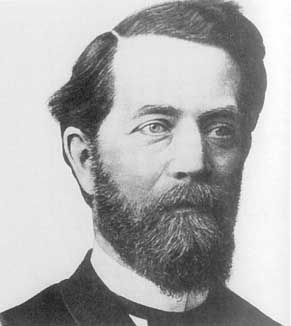
Felix Klein — from Wikimedia.

The book begins with a discussion of arithmetic from an axiomatic perspective, and then transitions into a more philosophical discussion about the certainty of mathematics. In the course of the philosophical discussion, Klein articulates the difference between idealism and formalism in the following way:
While we were discussing the first point of view [= the idealism of Kant and others], we took the position that the certainty of mathematics rests upon the existence of intuitional things which fit its theorems. The adherents of this formal standpoint [= Hilbert's], on the other hand, must hold that the certainty of mathematics rests upon the possibility of showing that the fundamental laws considered formally and without reference to their intuitional content, constitute a logically consistent system. (p. 13; emphasis in original)
Putting the contrast in these terms pinpoints the crux of the Frege-Hilbert debate nicely, I think. The two philosophers were simply looking for two different kinds of proofs of the certainty of mathematics: Frege, a correspondence between math and some stuff in the idealized Kantian mind; and Hilbert, a technical proof of the harmlessness of a particular tool.  Obviously, a debate beginning from such divergent conceptual standpoints was doomed to frustration.

Tuesday, December 18, 2012

Roger Bacon: Compendium of the Study of Theology (1292)

Medieval scholasticism has a reputation for mindlessly accepting ancient authority; but some of the things Roger Bacon wrote suggest that there is a bit more nuance to that picture.

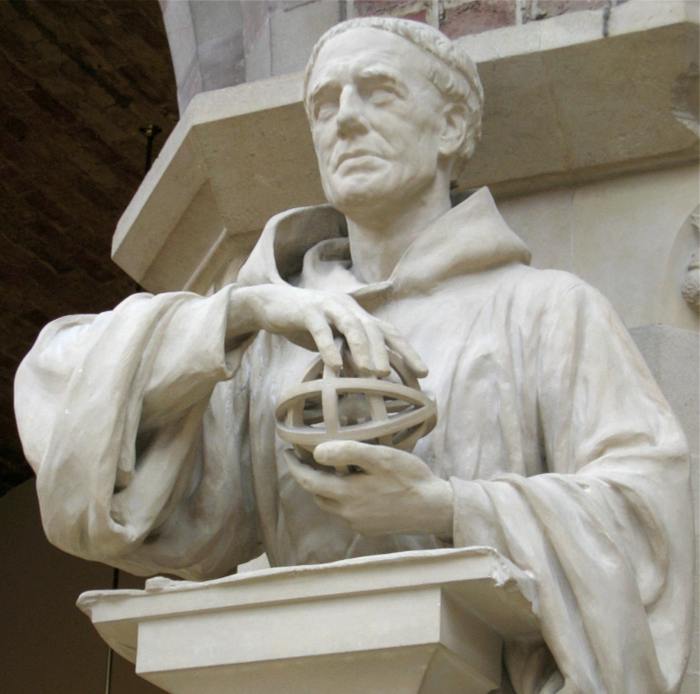
Roger Bacon (source: Wikimedia).

In the very last book he wrote, Bacon included an introductory chapter on "the general causes of human errors" (ch. 2, section 6). This chapter includes, in rapid succession, two quotes that seem to reject the power of authority more than anything else (in section 8):
With just how much discretion authority is to be examined Aristotle bears witness in the first book of Ethics when he says, "If two friends exists, Plato and truth, one should align oneself more with truth than the friendship of Plato." […] But few wish to examine the words of their teachers, which Boethius condemns in [his] book On the Training of Scholars saying: "A low-grade talent always uses the things discovered and never those to be discovered; and it is [even] more foolish to trust entirely the sayings of academic authority. […]"
 Here's the Latin:
Quanta vero discretione examinanda est auctoritas, Aristoteles primo Ethicae testatur dicens, "Duobus existentibus amicis, Platone et veritate, magis consentiendum est veritati quam amicitiae Platonis." […] Sed pauci volunt examinare dicta suorum magistrorum, quod reprobat Boethius libro De disciplina scholarium dicens, "Miserrimi ingenii est semper inventis uti, et nunquam inveniendis; stultiusque est magistratus orationibus confidere omnino. […]"
 

Monday, December 17, 2012

Foucault: "What is Critique?" (1978)

"What is Critique?" is a title that Sylvère Lotringer, the editor of The Politics of Truth (1997, 2007), gave to a lecture Foucault gave in 1978.

Towards the end of the lecture, Foucault himself says that he could have given the talk the title "What is the Aufklärung?" but that he "did not dare" (p. 67). The anthology does however print the lecture right next to Kant's text with a palpable tension as a result.

The lecture is notable both for framing Foucault's own writings as a certain species of Enlightenment thought, and for containing an interesting discussion of the notion of governmentality. He says:
How to govern was, I believe, one of the fundamental questions about what was happening in the 15th or 16th centuries. It is a fundamental question which was answered by the multiplication of all the arts of governing—the art of pedagogy, the art of politics, the art of economics, if you will—and of all the institutions of government, in the wider sense of the term government had at the time.
So, this governmentalization, which seems to me to be rather characteristic of these societies in Western Europe in the 16th century, cannot apparently be dissociated from the question "how not to be governed?" I do not mean by that that governmentalization would be opposed in a kind of face-off by the opposite affirmation, "we do not want to be governed and we do not want to be governed at all." I mean that, in this great preoccupation about the way to govern and the search for the ways to govern, we identify a perpetual question which would be: "how not to be governed like that, by that, in the name of those principles, with such and such an objective in mind and by means of such procedures, not like that, not for that, not by them." And if we accord this movement of governmentalization of both society and individuals the historic dimension and breadth which I believe it has had, it seems that one could approximately locate therein what we could call the critical attitude. (p. 44)

Wrighton: Elementary Principles of Probability and Information (1973)

This is a strange little book. It is essentially an introduction to information theory, but with a bunch of digressions into all sorts of philosophical and methodological issues. It's not always completely clear to me where Wrighton is going with his arguments, but some of them are quite thought-provoking.

The Reshuffled Hierarchy of Science

The book begins with a discussion of what probability is, using the philosophy of Giambattista Vico as a starting point.

A core claim of Vico's philosophy is, according to Wrighton, that the sciences should not be sorted on a scale with mathematics and theoretical physics in one end, and social and human science in the other. Rather, one should categorize them according to the artificiality of their objects:
Mathematics retains a special position, since in mathematics Man creates the object of his study, which therefore he wholly understands. Likewise, Man may hope to acquire an understanding of comparable depth within the humanities; for he has created his own history, his own language and his own social environment. The Natural Sciences suffer a demotion, relative to the ideal of certainty, and revert to the status which Bacon accorded them; experiment and observation provide, and must always provide the true foundation of physics, since, as Vico puts it, Man can never wholly understand what God has created; physical theory primarily reflects, or epitomises, man's increasing control over his physical environment, rather than an independent reality. (p. 3)
A crude way of putting the same point would be that math is a human science. Whatever is conceptual, mental, or cultural falls on one end of of the scale, and the study of natural phenomena falls on the other.

Probability as Deliberately Created Uncertainty

Once we have reshuffled the sciences like this, we have to decide whether we categorize probability theory as a study of "Man's creation" or of "God's creation." Here, Wrighton squarely comes down on the side of the first team:
It is sometimes said to be a mere empirical fact that when a coin is tossed it comes down heads with probability one half; and that a suitably-devised machine could toss coins so that they came down heads every time. The suggestion is based on a total misconception. A coin comes down heads with probability on half because we arrange that it should do so: the empirically-verifiable consequences cannot be other than they are. If an operator, within the terms of our instructions to him, were to train himself to toss a coin so that it always came down heads, we should have to regard our instructions as misconceived, and would either have to raise the minimum angular momentum assigned or supply him with a smaller or lighter coin: it is a matter of making the task implicitly assigned to the operator sufficiently difficult. Thus we cannot think of a random event without somehow involving a human being in its generation. (p. 3; his emphasis)
So "real" probability is "artificial" probability; a random experiment is an experiment that allows us to say that something went wrong if it is predictable. Only metaphorically can we transfer this artificially created complexity to natural systems.

Points of Contact

I find this idea interesting for two reasons:

First, it turns information theory upside-down so that system complexity becomes more fundamental than probability. This is an interesting idea also championed by Edwin Jaynes, and which I have been exposed to through Flemming Topsøe.

And second, it relates the philosophical problems of probability theory to the thorny issues surrounding the notions of repetition, identity, rule-following, and induction. It is probability fair to say that one can't solve any of these problems without solving the others as well.

Michael Billig: Arguing and Thinking (1987)

In chapter 2 of his (highly recommended) book on rhetoric, Michael Billig offers an interesting critique of the frequently invoked reductions of argumentation to a kind of game or a kind of theater.

His argument is that even games involve a certain amount of arguing and disagreeing, and that the metaphor has to obscure this fact (on pain of infinite regress). Or put differently, if arguments are games, they are games whose rules are settled by even more games:
If there is a resemblance between arguments and games, then also arguments can resemble games which never quite get played. It is as if two captains are picking sides in a playground before playing a game to settle an argument. However, they cannot agree how to pick the sides, and therefore they decide to play a second game the winner of which can describe how to pick the sides for the first game. The second game requires that sides be picked, and that provokes a further row, which is to be settled by a third game. And, thus, there looms the prospect of infinite disagreement about the rules, all to be settled by further games, whose rules are disputable. Therefore there is an infinite of disagreements which can be aired, before the teams can line up with agreed rules. (p. 25–26)
This is closely related to what he terms "Protagoras' principle," i.e., the idea that there are arguments for and against any point. Any statement can be called into question at any time, so argumentation is not guaranteed to ever reach a bottom layer of unanalyzed shared assumptions.

Tuesday, December 11, 2012

Vendler: "Verbs and Times" (1957)

As with his paper on quantifiers, I read this paper in Linguistics in Philosophy (1967), but it first appeared in Philosophical Review in 1957. It's also floating around the internet here and there.

The Aspectual Garden

The paper is essentially a presentation of a taxonomy of verbal aspects.

Vendler makes a distinction between verbs that express states, and verbs that don't. Among those that don't, he distinguishes between those that have no clear end goals, and those that do.

Among processes with end goals, he distinguishes between those that consist only of a change of state, and those that consist both of an extended process and a change of state.

Here is his taxonomy with the names he uses:
  • States are extended processes which involve no action and produce no change;
  • Activities are extended processes which involve action but still produce no change;
  • Accomplishments are extended processes which culminate in a change of state;
  • Achievements are punctual events which consist of a change of state.
In my textbook on semantics, these classes are described by sorting them first according to the static/dynamic dimension, and then by plugging the dynamic verbs into the four cells of a table with a telic/atelic dimension and a durative/punctual dimension.

The result of this analysis is that Vendler's "achievements" are split into two classes: punctual atelic semelfactives and punctual telic achievements. Activities would then be the durative atelic processes, and accomplishments would be the durative telic ones. All static verbs are still lumped together in one big class called states.

This alternative model is taken from Carlota Smith's The Parameter of Aspect (first edition, 1991).

Diagnostics for the Classes

Vendler's taxonomy involves three different dimensions of difference. He himself proposes a number of tests that can distinguish the two poles of each dimension.

The Progressive Test

The easiest distinction to make is the one between static verbs and everything else. As Vendler notes, only dynamic verbs accept progressive forms (p. 99), so one can't say things like
  • *I am resembling …
  • *I am owning …
  • *I am resenting …
For the same reason, one can also not answer the question
  • What are you doing?
with a static sentence.

The Completion Time Test

Since telic processes have an implied end state, it makes sense to ask how long such a process took (to accomplish). For atelic processes, this frequently makes less sense (p. 100–101):
  • I takes me forever to write an email. (durative, telic)
  • *It took me all afternoon to sit in my chair. (durative, atelic)
  • It took the bomb an hour to explode. (punctual, telic)
  • ?I took me an hour to cough. (punctual, atelic)
However, this test is not very reliable, since one can also construe the atelic verb as designating a desired end state of some other process. For instance, if I want to sneeze but can't, the sentence it takes me a long time to sneeze sound less weird.

A bit of googling shows that people occasionally do write things like that. The verb sleep also provides a good problematic example.

The Temporal Extension Test

Reversely, one can ask for the amount of time spent on an atelic process, but not a telic one:
  • *I wrote an email for an hour. (durative, telic)
  • I sat in my chair all afternoon. (durative, atelic)
  • *The bomb exploded for an hour. (punctual, telic)
  • I coughed for an hour. (punctual, atelic)
However, this test also rules out atelic processes that can not easily be "ground" into repeated actions:
  • *I took a breath for an hour. (punctual, atelic)
  • ?I sneezed a single time for an hour. (punctual, atelic)
  • *He died throughout 1918. (punctual, atelic)
The test can thus only reliably be used to distinguish between telic and atelic processes in the durative case. In the punctual, things might go wrong.

The Homogeneity Test

Although durative telic processes have a completion time, this completion time cannot be interpreted as a temporal extension. If it took me an hour to reach the summit, that doesn't mean that I was engaged in an activity called "reaching the summit" in that whole period (p. 104).

This difference can also be exploited in a test:


I wrote my first draft between 9 and 12                 
–––––––––––––––––––––––––––––––––––––  (invalid?)
I wrote my first draft between 10 and 11.                


I ran aimlessly around between 9 and 12             
–––––––––––––––––––––––––––––––––––––  (valid)
I ran aimlessly around between 10 and 11.            


I realized how wrong I was between 9 and 12                 
–––––––––––––––––––––––––––––––––––––––  (invalid)
I realized how wrong I was between 10 and 11.                


I coughed loudly between 9 and 12              
–––––––––––––––––––––––––––––––  (valid)
I coughed loudly between 10 and 11.             


However, this test isn't perfect either. While it does select precisely the atelic processes in these cases, the test might actually reject paradigmatically telic processes like write a letter or draw a circle. It is not always clear that the time interval pertains to the end point of the process rather than the process as a whole.

The Twice Test

Vendler doesn't mention this, but it should be mentioned that although we can almost always "grind" punctual processes into durative ones, we can counteract this tendency by insisting one counting the events in questions:
  • I blinked twice.
  • I blinked for an hour.
  • ?I blinked twice for an hour.
To see to what extent this test is able to separate durative from punctual verbs, we can try to plug sleep into the same frame:
  • I slept twice.
  • I slept for an hour.
  • I slept twice for an hour.
Is this last sentence acceptable? If so, we have a working diagnostic; if not, we have a problem.


The Spot Test

Although punctual processes can almost always be "ground" into durative ones, it is difficult for a punctual verb to have a durative complement. Concretely, Vendler notes the difference (p. 114):
  • I saw him run.
  • I saw him cross the street.
  • *I spotted him run.
  • *I spotted him cross the street.
This observation, however, does not sit easily with the fact that you can realize how wrong you were or, even worse, that you can realize how wrong you always were.