Tuesday, October 28, 2014

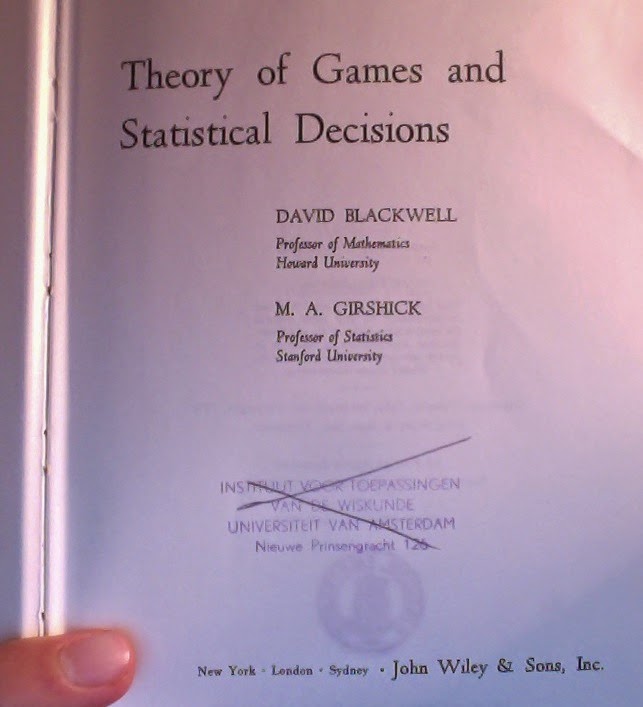
Blackwell and Girshick: Theory of Games and Statistical Decisions (1954), Ch. 4

There's an interesting representation theorem in Blackwell and Girshick's textbook in statistics: It provides a set of sufficient conditions for a preference ordering over lotteries to be expressible as a prior probability distribution (Th. 4.3.1, p. 118).

I assume the theorem comes from either Wald, Savage, or de Finetti, but no reference is given.

Well-Behaved Preferences

A lottery can here be defined as a function from the sample space to the real numbers. The conditions in the theorem are then the following:
  • The ordering of two lotteries $f$ and $g$ cannot depend on the availability of other lotteries.
  • If a lottery $f$ provides a higher payoff than a lottery $g$ at all points in the sample space $\Omega$, then $f$ must be preferred to $g$.
  • If $f$ is preferred to $g$, then $f+h$ must be preferred to $g+h$.
An inspection of the proof also shows that they should have included a continuity condition:
  • If $f_1, f_2, \ldots$ is a series of lotteries converging to a limit $f$, and if $f_i$ is preferred to $g$ for all $i$, then $f$ must also be preferred to $g$.
When these conditions are met, the preference ordering over the lotteries can be expressed as a distribution over the sample space, unless it categorizes all lotteries as equally good.

The Large and the Good

The proof of the theorem uses the fact that two convex, disjoint, open sets can be separated by a hyperplane. Here's a sketch:

If we let $e$ be the lottery that pays zero in all situations $\omega \in \Omega,$ then we can define the following sets:
\begin{eqnarray}
F[>] &=& \{f\ |\ \forall \omega \in \Omega: f(\omega) > 0\},
\\
F[\gtrsim] &=& \{f\ |\ f\gtrsim e\},
\end{eqnarray}
and we can further define, in the usual way, $F[>] + F[\gtrsim]$ to be the sums of lotteries from those two sets.

Now, $F[>]$ is an open set, and hence $F[>] + F[\gtrsim]$ is, too. Further, $F[>]$ and $F[\gtrsim]$ are both closed under addition (due to the third assumption), and hence their sum is, too. They are also both closed under multiplication with a scalar, and again, so is their sum — but this latter argument requires a bit more spelling out.

Rational and Real Convexity

Suppose a lottery $f$ is preferred to the zero lottery, that is, $f \in F[\gtrsim]$. The third assumption of the theorem then tells us that
$$
e \;\lesssim\; f \;\lesssim\; f + f \;\lesssim\; f + f + f \;\lesssim\; \ldots \;\lesssim\; nf.
$$
By further adding multiple copies of the zero lottery to both sides of this preference ineqality, we can see that
$$
me \;\lesssim\; (m-1)e + nf \;=\; nf,
$$
where we have selectively used the fact that $e$ is the zero lottery. Putting these facts together, we then have the preference inequality
$$
e \;\lesssim\; \left(\frac{n}{m}\right)f.
$$
By using a positive sequence of rational approximations $(n/m) \rightarrow \lambda$, we can use this fact along with the continuity assumption to conclude that $F[\gtrsim]$ is closed under multiplication with any positive, real scalar $\lambda$.

I don't think there's a way around this last technicality. It is, incidentally, the same proof technique used to prove that the logarithmic functions are the only continuous functions that turn products into sums.

Cutting the Cake

At any rate, $F[>] + F[\gtrsim]$ is an open and convex set separated from the singleton set $\{e\}$. We can therefore conclude that there is a lottery (or vector) $p$ which defines the hyperplane $\{f\ |\ f\cdot p=0\}$ separating $F[>] + F[\gtrsim]$ from $\{e\}$. The set $F[>] + F[\gtrsim]$ is thus a subset of the half-space $\{f\ |\ f\cdot p \geq 0\}$.

This vector $p$ must have nonnegative coordinates, since the set $F[>]$ is unbounded in all positive directions. If $p$ had a negative coordinate, $p(\omega) \leq 0$, we could choose a lottery for which the corresponding coordinate, $f(\omega)$, was so large that $f\cdot p < 0$. This would violate the definition of $p$, and $p$ hence has to be a nonnegative vector which can be interpreted as a probability distribution.

It would also have the property that $f\cdot p \geq g\cdot p$ if and only if $f \gtrsim g$. This follows from the fact that $f\cdot p \geq g\cdot p$ if and only if $(f - g) \in F[>] + F[\gtrsim]$, which holds if and only if $f$ can be expressed as the sum of $g$ and some lottery preferable to the zero lottery.

Friday, September 26, 2014

David Publishing Co. is (also) a scam

Yet another unsolicited email from a predatory publishing company:
… we invite you to submit this paper and related research papers to Psychology Research.
The new journal of Psychology Research, an award-winning peer-reviewed, multidisciplinary periodicals published by David Publishing Company, New York, NY 10034, USA., since July, 2011, welcomes the submission of original manuscripts reporting innovations or investigations in the Psychology area. Successful general submission manuscripts may report interdisciplinary efforts or be of a sufficiently broad nature to be of interest to those centered in related disciplines. Manusripts reporting innovations or collaborations leading to enhancements in Psychology are of particular interest to Psychology Research.
If you have the idea of making our journals as vehicles for your research interests, please send your WORD format manuscripts (papers or books) through e-mails/submission system (for more details refer journal Web page). We appreciate your support.
We also seek researchers who have deep research in and outstanding contribution to Psychology area to be our reviewers/editors. Good review board has insightful understanding in Psychology field, and can provide professional suggestions to authors. Anyone who is interested in our journals can send us CV. We are looking forward to your contribution!
Sincerely yours,
Lily, R.
Editor OfficePsychology Research, ISSN 2159-5542
David Publishing Company 240 Nagle Avenue #15C, New York, NY 10034, USA.
Italics, boldface, and typos in the original.

Some comments by other people:

Monday, September 15, 2014

Lambert Academic publishers is a scam

I've just received an email from company "Lambert Academic Publishing," a daughter company of the VDM group.

After making a reference to a conference abstract of mine which appears on a university website, the email continues:
As an international publisher whose aim is to disseminate research to a global audience, we would be especially interested in publishing your dissertation (or a recent scientific monograph) in paperback form.
I would greatly appreciate if you could confirm your interest in receiving a brochure with details about our services.

I am looking forward to hearing from you.

--
Kind regards/Freundliche Grüße

Ilie Tsilea
Acquisition Editor

LAP LAMBERT Academic Publishing is a trademark of:
OmniScriptum GmbH & Co. KG

Heinrich-Böcking-Str. 6-8,
66121, Saarbrücken, Germany
This email and the company behind it is a scam — not exactly in the sense that the company doesn't exist, but in the sense that it applies aggressive and misleading sales tactics to feed off the insecurity and publication pressure of the academic world. If you receive an email from them (probably one that will be eerily reminiscent of the one quoted above), I recommend that you don't reply.

A number of other people have already written about the company, so I'll let them explain:
I'm sure there are more cautionary tales out there, but these should do.

Urban: Language and Reality (1938)

The American philosopher Wilbur Urban seems to have been one of the most vocal advocates for the philosophy of Ernst Cassirer in the English-speaking world. Most references I've seen to his work point to the 1938 book Language and Reality.

I haven't familiarized myself very much with this massive book, but it seems that its general thesis is that a phenomenological metaphysics can be reconstructed on the basis of a careful analysis of language. This involves, among other things, an inspection of what he calls "radical metaphor."

Wilbur M. Urban; uncredited photo snatched from this website.

Urban writes:
It has repeatedly been pointed out that metaphor, in the sense here understood, must be clearly distinguished from metaphor in the conscious reflective activity of the poet. It is rather the unconscious activity that is creative in language itself. (p. 176)
The essence of radical metaphor is that it is intuitive and involves the intuitive meaning which we analysed out and described in the preceding chapter. This is seen especially in the Erlebnis-Wert of the adjective. The transfer of the coldness of ice to the coldness of a reception, the height of a tree or mountain to nobility, the dirt of the streets to the dirt of the Yellow Press—in all such cases we recognize a certain natural affinity or likeness between the objects which makes the transferences natural and even inevitable. (p. 177)
It is true that such transfers may often be conceptually justified, but such a "verification" is always ex post facto. The transfer of the cold of the ice to the cold of a reception … may be thus justified. It consists in arguing that when A is to B as C is to D, the name A can be used to indicate C. But such validation is significantly different from the self-authenticating process by which the transfer takes place. (p. 178)
A recurring theme in these analyses is that language "moves upwards" in the sense of transferring meaning from concrete, physical concepts to more abstract or "spiritual" ones. Thus:
The general upward movement of language "from the physical to the spiritual," the transfer of names, analogical predication with the accompanying development of ontological predicates, creates an entire region or universe or discourse which is post-logical or metalogical in this sense. (p. 331)
… this "figurative" use of language is not so much a fanciful expression for something otherwise known, as the means of apprehending and fixating new aspects and meanings. The natural movement of language, the upward movement as we described it, is from the physical to the spiritual. All words are physical in their origin and have a physical reference. It is through metaphorical transfer that they acquire their new references, their second intentions, but they acquire these new references because they becomes the vehicle for the intuition and description or expression of new entities. (p. 345)
But these very figurative expressions are expressions precisely because they are representative, or rather constitutive, of the intuitions themselves. Here intuition and expression are one, for the reason that the figurative expression itself is part of the apprehension or knowing. (p. 345)
Although Urban muddles the point a bit, I think his take on the relation between metaphorical language and thought is that the language influences the thought. At least, this is what he appears to be focus on most of the time, perhaps because it is the most controversial direction of the claim.

His remark about "expressions" does seem to indicate, however, that he has some kind of phenomenological authenticity criterion in mind too. This could mean that he also considers figurative language to be an expression of certain cognitive "intuitions," although these intuitions may also, in a circular fashion, have been put there by the language shared by a given culture.

I. A. Richards: Interpretation in Teaching (1938)

Now, here's a thought:
Thinking is radically metaphoric. … To think of anything is to take it as of a sort … and that 'as' brings in (openly or in disguise) the analogy, the parallel, the metaphoric grapple or ground or grasp or draw by which alone the mind takes hold. (pp. 48–49)
My point is not that language is full of metaphors … It is that thought is itself metaphoric – not merely that it expresses itself in linguistic metaphors. The metaphor that a thought is using need not correspond to the metaphor that its language displays, though it usually does, and the thought will often adopt the verbal metaphor when it is noticed. But equally often we discount and disown the metaphors in our speech, treat them as dead, or kill them as we go. (p. 49)

Friday, September 12, 2014

Gardner: "Metaphors and Modalities" (1974)

This paper (by the later very famous developmental psychologist Howard Gardner) reports on an experiment in which college students and children of different ages were asked to apply adjectives like hot/cold to stimuli like uncommon stimuli like faces, color samples, or small objects. The young children were quite good at this, with some caveats.

The experiment is notable for employing materials that are not entirely obvious clichés, like the connection between big/small size and high/low tones.

In one task, for instance, the subjects to felt sandpaper of various degrees of coarseness, then deciding which of the two types of sandpaper was the more light, and which was the more dark. Other stimuli included as ping-pong ball vs. a jack (presumably meaning the edgy die used in playing the jacks), or the sound of a triangle vs. the sound of a recorder.

Table of materials used in the experiment; p. 86.

In general, Gardner found that even preschool children agreed more or less with the judgments college students made on these tasks. A notable exception was the application of color terms to new stimuli, something that seems to indicate a heavily conventional component in color metaphors, such as a blue tap for cold water (p. 88).

The smaller children also gave a number of bizarre, funny, and "incorrect" explanations for their choices. For instance,
The 7-year-old[s] equated "getting lots of presents on your birthday" with dark and "getting no presents" with light, because, as several subjects explained, "lots of presents are heavy to carry." Here the contrast to light/dark was apparently assimilated to light/heavy. (p. 88)
Also, the children equated
… a tactile-perceived Ping-Pong call with loud and a tactile-perceived jack with quiet; in this case, subjects reported that the Ping-Pong ball would make more noise if it fell, Here an action in which the elements might be involved overwhelmed the more conventional association of pointed compactness with noise and smooth emptiness with silence. (p. 88)
In both of these cases, the older children and the college students tended to arrive at the opposite conclusions.

The 11-year-olds in the study, by the way, also tended to answer that
[an] angry face is cold "because it makes you feel cold" (p. 88)
a finding that sits somewhat uneasily with Zoltán Kövecses' insistence on the universality of ANGER IS HEAT metaphors.

Wigod: The Matter of Metaphor and Its Importance for Linguistics (1972)

Chapter 10 of this MA thesis contains some useful references to state of metaphor theory in the early 1970s. I don't know anything about the author, but a bit of googling suggests that she now works in Canada as a journalist.

Notables

Wigod's own take on the cognitive underpinnings of metaphorical speech is that "metaphor is man's cognizing tool par excellence, and quite possibly his only such" (p. 84).

She also quotes John Middleton Murry as saying that "metaphor appears as the instinctive and necessary act of the mind exploring and ordering experience," and that the lexis of a language is "the record of past cognitive exploration." Both of these quotes come from his essay in the anthology Essays on Metaphor edited by Warren Shibles (1972; pp. 28 and 93, respectively).

A number of interesting quotes are also given from William Hilton Leatherdale's The Role of Analogy, Model, and Metaphor in Science (1974). Leatherdale claims that metaphor is "indispensable for positing hypotheses" in science (p. 133), and it leads to "a multi-dimensional, gestalt-like insight into new ways of looking at phenomena" (p. 22).

Wigod also explains that
… Leatherdale cites another two-fold classification of analogies. The first type is the observation of a simple resemblance, which is basically transparent common-sense cognizing. The other type is more prodigious, and compares one relation (in the mathematical sense) to another. (p. 87)
This sounds amazingly like the distinction between metaphor and analogy later emphasized by Dedre Gentner.

A Digression on Margaret Mead

Wigod also quotes Terence Hawkes as quoting Margaret Mead as saying that
… the metaphor we may embody in the statement 'Love will find a way' may simply not exit in some countries, or may have an utterly different role (and so call forth appropriately different responses in others. (p. 96 in Wigod's text)
But this is almost certainly a spurious quote. The source seems to be a passage from Mead's 1949 book Male and Female:
To get some sense of the experience an anthropologist brings to the consideration of a human problem, let us take the simple statement "Love will find a way," a well-worn and well-loved adage of our own tradition. To a young American, this phrase will conjure up images of difficult transportation, a determined young man thumbing his way across the United States, or driving thirty-six hours stopping only for hot dogs, to get there in time to see his girl—before she sails or decides to marry someone else. Or it may mean the way in which a girl plans, and saves, and even sews, to divise the dress that she then wears to the dance where she knows her estranged lover will see her and may choose her again. Through one's head will pass a variety of plots and incidents: motor cars, jobs, shortages of cash, failures of plane connections, occasionally even recalcitrant parents if the lovers are young enough or the parents rich enough for their views to matter. Mixed up with images from one's own experience will be snatches of scenes from movies, from novels, from radio serials, occasional images of Tom Mix riding across the plains, or Ingrid Bergman in some over-intense role, perhaps a line or so from Romeo and Juliet, or a couplet from an old valentine.
I don't have the rest of the quote, but I can see that it occurs in chapter 2 of the book ("How an Anthropologist Writes"), on page 35 of the 1949 edition, if I'm not mistaken.

The Works

In addition to these texts, Wigod cites the following useful references: